
Disclaimer: Sofirn provided me with this light free of charge. This had no influence on the review
Introduction
I already liked the SE1 without the Pro version, both in copper and in aluminum. Unfortunately my silver SE1 fell victim to the washing machine - a great reason to take a close look at the SE1 Pro!
Specs by Sofirn


The SE1 is available with and without this review is about the SE1 Pro. It is available in many colors, here I am presenting the dark cherry version.
Package Contents and Impressions


Anyone who owns the copper SE1 will be surprised at how small the packaging is - despite the large selection of accessories! Included, besides the flashlight with integrated battery, is a clip mount where the light is docked magnetically, an elastic armband which can be combined with the mount, a ball chain, a key ring attachment, a USB-C-C-cable and a manual.

When you take the flashlight out of the box, you not only have to unlock it, but you should also remove the protective film in front of the TIR optic.
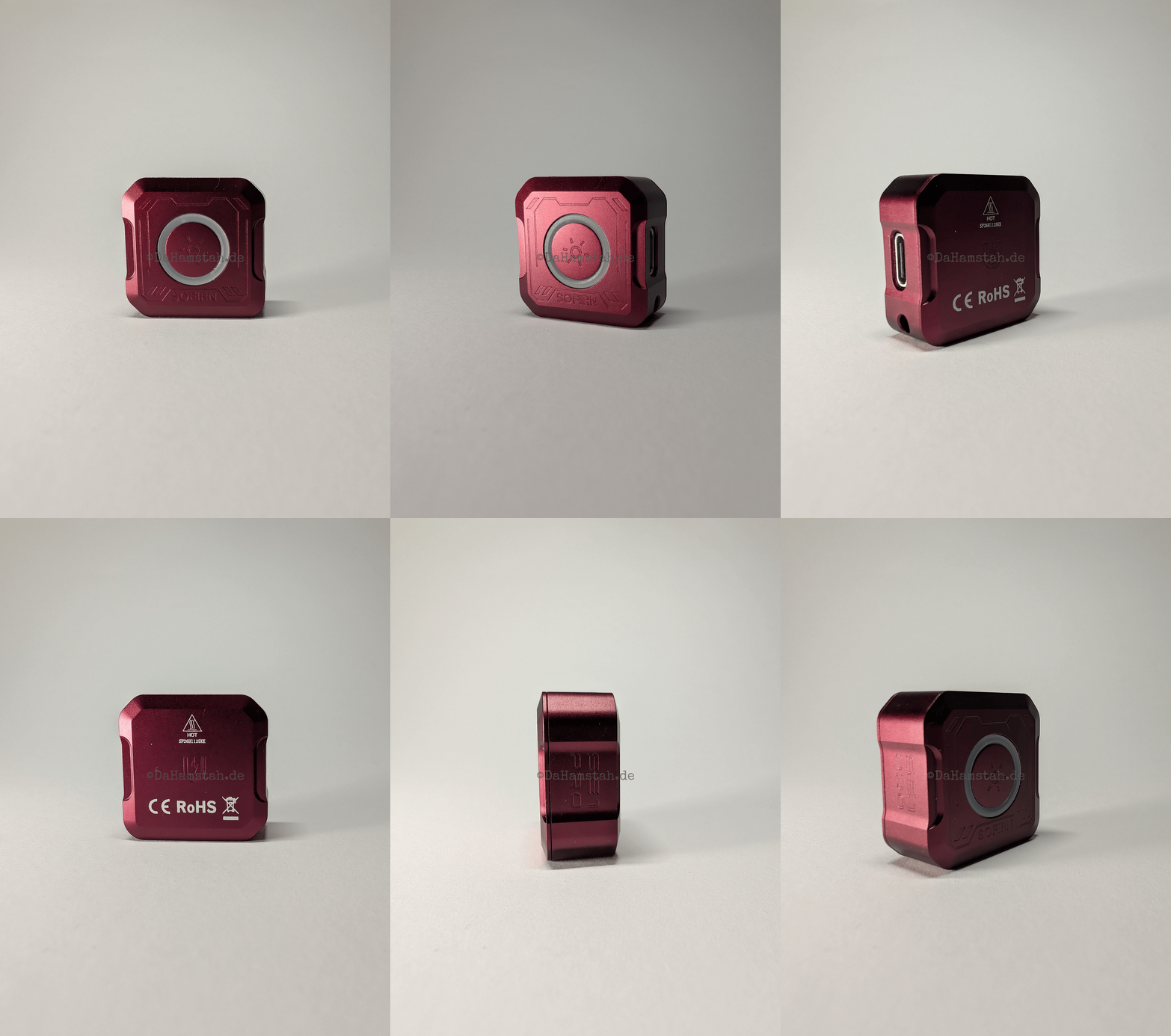
The exterior of this small flashlight remains unchanged from the SE1. A modern aluminum body with really nice anodization, without sharp edges or other flaws, surrounds the new technology inside the light.

The top with the switch and the illuminated ring around it has also remained the same. The switch has good tactile feedback and sits flush with the surrounding, recessed matte-translucent ring. This ring has various functions, among other things it also serves as a battery level indicator.


Where previously a cool white LED and a UV-LED sat behind the double-TIR optic, a lot has changed in the new version. The cool white (6500K) LED has been replaced with a neutral white (5000K) high CRI variant. The 395nm UV LED was replaced by an RGB-LED. Instead of a UV-LED, which is very limited by the TIR optic, you now get 3 truly functional colors - I like that a lot, even though I have to admit that I do not have a direct use for either.

There is also a USB-C-port on the side of the flashlight. This is not further protected by a cover. Since the flashlight is rated IPx5, I do not assume that it is internally sealed.
Size

My scale shows a slim 20g for the flashlight, the calipers read 30x30x14mm.
Carrying Options

Lanyard: A real lanyard is not included, but the key ring with attachment loop also serves well as a "mini-lanyard" where you can put a finger through the ring.
Clip and Armband: There is no clip on the flashlight itself. However, the extensive accessories of the light help here. There is a plastic mount where the flashlight can be docked magnetically - oriented in all 4 directions. On its back is a clip - a really good one, actually! The jaws are rubberized, the tension is good, the opening as well. You can either place the armband into the clip-opening or thread it through an extra slot in the mount to attach it a bit more permanently.


Magnet: A magnet is integrated into the bottom of the flashlight, opposite the switch. This is sufficiently strong, the light will certainly not fall off smooth surfaces on its own and holds well even on uneven or slightly rounded surfaces.

Necklace: The accessories also include a ball chain. With this, the flashlight can be worn very comfortably around the neck, the length is well proportioned. Similar to a dog tag, the light will not fall off on its own, but will break away before you could injure yourself on it.
(Jacket)pocket: As written above, the SE1 has already fallen victim to my washing machine - in a pants pocket. I think that speaks volumes about how unobtrusive the small and lightweight flashlight is in any kind of pocket. You simply notice that the light is designed exactly for this.
UI

The UI of the flashlight is extensive, but not complicated. On the contrary - the basic operation is the same across all light sources, the selection of the light source is clear. Sure, a small flashlight with a white LED, an RGB-LED and an illuminated ring will never be as simple as a light with just a single switch, but Sofirn has definitely thought the UI through and implemented it well.

| State of the light | Action | Result |
|---|---|---|
| off | 1C | on, last used brightness level of the white light |
| off | 1H | ring |
| off | 2C | RGB |
| off | 3C | lock |
| flashlight locked | 3C | unlock and turn on in the last used level |
| flashlight locked | 1H | moonlight |
| on, white light | 1H | Change brightness level |
| RGB | 2C | red -> green -> blue -> ... |
| RGB | 1H | Change brightness level |
| RGB | 3C | Rot-blauer Strobe („Police-Strobe“) |
| ring | 2C | Switch between red -> breathing -> warning flash -> rainbow -> ... |
| on | 1C | off |
Below you can see all the possibilities of the ring on the top.


Beam Profile and Measurements
All measurements were taken in my 30cm integrating sphere. The temperature was between 24 and 28°C. Furthermore, an Opple Light Master III and a TASi TA636B lux meter were used. Please note that this is hobbyist equipment, so inaccuracies and deviations are possible! With lights like the M1, slightly larger deviations can occur, especially when only one of the two light sources is on.
Output and Beam
The flashlight definitely feels most comfortable in the near field up to 5m in front of your feet. Sure, it illuminates further, but it is a small light with limited throw. However, I really like the beam pattern with a clear hotspot that is well separated from the spill. Sure, you can see minimal artifacts on a white wall from a short distance, but you really have to look for them.
The colors prove to be interesting. The multi color LED, in combination with the small TIR optic, does work and produces a reasonably clean illumination, but with a small peculiarity. If you hold the flashlight with the switch facing up, blue visibly shines upwards, green downwards to the right and red downwards to the left. This is not a problem, as you can easily tilt the light, I just thought it was worth mentioning.

I cannot measure the brightness of the colors, therefore you will find the runtimes in the following chart - these are not in proportion to each other, it is purely about the curves.

For the white light, of course, the measurements are complete. Small flashlight, small battery - even if the light is made of aluminum on the outside, the LED-board probably does not have too much contact with the flashlight body and the small battery does the rest. Sustainably, about 60 lumens are possible, which is more than enough for such a small light. The highest brightness level provides a short boost, which then shortens the runtime accordingly.

| mode | Max. in 1. minute | Lumens at 30s | max. temperature | runtime |
|---|---|---|---|---|
| Sofirn SE1 Pro high | 299 lm | 266 lm | 37.0 °C | 59 min |
| Sofirn SE1 Pro medium | 64 lm | 63 lm | – | 1h 13min |
| Sofirn SE1 Pro low | 9 lm | 9 lm | – | 6h 33min |
I measured the flashlight at 1394cd and thus a throw of 75m.
CCT, CRI, DUV, PWM
| Low | Turbo | |
| CCT | 5300 | 5400 |
| CRI | 100 (according to LMIII - very likely closer to 95) | 95 |
| DUV | 0,009 | 0,000 |
Flicker is in the green zone, I could not detect PWM with the naked eye nor with the camera.
All raw test data can be found here.


Beamshots
For the beamshots I chose the flashlights that can also be seen in the comparison above - I left out the TS10, as it plays in a different league regarding brightness. The photos were taken from a distance of 1m with identical camera settings.


Batteries and charging

The charging curve is flawless, it shows a Standard-CC-CV-process. However, the battery indicator switches to green before the charging process is completely finished. This is not a bad thing and tends to protect the battery, not much capacity is missed either. You can even spot the switching of the ring in the chart if you look closely, there is a small bump there. I have marked the spot. The capacity of the battery at full charge is (calculated) ~145mAh, so the capacity rating is accurate as well.
Summary
My biggest point of criticism regarding the SE1 was the 395nm-UV-light. Sofirn has replaced this and now gives you the choice of three colors. But even if you do not need the RGB function you get a good upgrade with the SE1 Pro - I like the 5000K high CRI LED much better than the cool white low CRI-variant.
Apart from that, all the highlights that existed before remain - especially the extensive accessory package and the well thought out user interface. The flashlight also remains an unobtrusive companion in any kind of pocket. If you then put that into perspective with the low price, there is nothing for me to complain about. On the contrary, the Pro-version is a great upgrade and gets my full recommendation!
With the many available colors, there should be something for everyone. For me, the flashlight is often allowed to tag along in my 5th jeans pocket, from the office to walking the dog. It cuts a fine figure everywhere! The light is even available as a multipack - check out Sofirn if you want to see the full selection!