
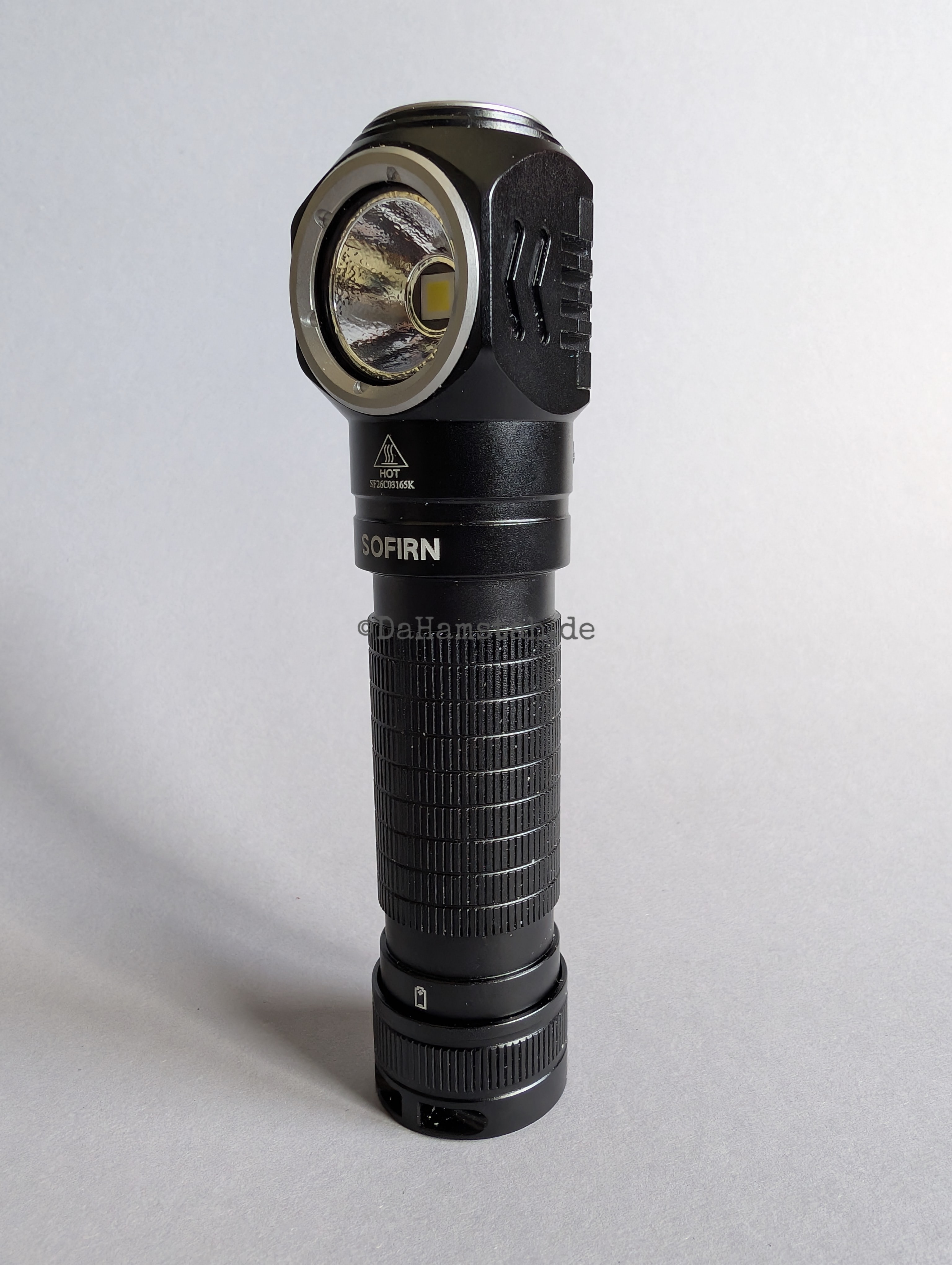
Disclaimer: Sofirn provided me with this light free of charge. This had no influence on the review
Introduction
An actively cooled right-angle light, large but still compact enough for headlamp use? 1,500 lumens sustained? Nothing like this has even remotely existed until now, so I was very curious to see if Sofirn really worked some magic here!
Specifications by Sofirn

There is currently only the one black version of the HS45. You can purchase the light directly from Sofirn.
Package Contents and Impressions
The light comes in typical Sofirn packaging, a white cardboard box with a print of the light and all the important details.

The light is securely held in a plastic tray inside the cardboard box. Next to it lies the headband, and underneath it a clip, a lanyard packed together with to spare o-rings, a USB-C-to-C cable, and a manual.

The light itself - Black, slightly glossy. There are no flaws in the workmanship to be found. Silver switch ring and bezel as accents. Quite inconspicuous at first glance.


But if you look at it from the side, it looks quite different, because you can see right through the head!


From the back, you can see the fan. Below it sits the USB port, which is sealed with a very well-fitting rubber cover. This is the big unique selling point of the light and always runs in High and Turbo. If you downshift, it continues to run. If you switch off, it stops. When first switched on, it starts up almost silently and then gets faster but when the light is warm, it starts at full speed immediately.
The small fan is audible, but even on the forehead, it is not to an extent that would be truly disturbing. Very slight vibrations are perceptible, which you can also hear when the light is lying on a table. In the headband mount, these are lost.
The airflow is barely noticeable and definitely not strong enough to suck anything in (hair, etc.).
Looking in the textured reflector, you can see the perfectly centered LatticePower HP50.1. Domeless, 4 dies. Read on to "Beam Profile and Measurements" to see how it performs.

From the top, you have a clear view of the switch. This is semi-transparent, with the battery indicator located underneath.


If you overlook the fan, you might think it's a pretty normal 21700 right-angle light.
The thermal camera nicely shows which parts of the light heat up and that the fan cover is thermally somewhat insulated on one hand and directly in the airflow on the other.


Potential Problems
Two problem areas in particular are being discussed on Reddit. I don't want to withhold my opinion on them from you.
1.: Exposed contacts on the fan.
These cannot be denied. I cannot answer whether they pose a problem in connection with the IPX6 rating. The Wuben X1 Pro, also IPX6, is constructed similarly and there too, the contacts and PCB of the fan are exposed. Whether the fan simply stops working upon contact with liquid and comes back to life after drying, whether nothing happens at all, or whether a permanent defect occurs, I cannot predict. A certain degree of caution when using the light in connection with water is therefore not wrong. My uses in the rain didn't harm it.
2.: Temperature regulation.
There is a reasonable suspicion that the light could become very hot in the event of a fan failure anyone who wants to see more can click here.
In normal operation, everything worked for me and I could not reproduce the result. I let the light heat up fully (with the fan rotated away) in Turbo to 60° head and over 40° body temperature, then switched to High and let the light run. In doing so, the light never got warmer than 50° after stepping down from Turbo - admittedly a different test than in the video.
Either way, one should be aware that the light could become very hot in the event of a fan defect. Anyone who wants to try it can set an Anduril light to the temperature maximum - warning, painfully hot!
Since this would be a defect of the light anyway, I decided to present it here but not to discuss it further for the review of the light.
Size

My scale shows 166g for the light.
The light is 125mm long, has a diameter of 27mm at the tailcap, and the widest diagonal at the head is 36.5mm.
Carrying Options
Lanyard: A simple lanyard is included and can be attached to the eyelet on the tailcap.


Clip: The clip itself is snapped onto the light body, which holds more than sufficiently. It fits the light well and works comfortably as long as the fabric is not too thick. If it is mounted towards the tailcap, the light carries almost deep carry. If it is mounted at the head, the head sticks out of the pocket.

Magnet: As long as the contact surface is good, the magnet holds sufficiently. If the contact surface is round, for example, I would only trust the magnet to a limited extent. So for my taste, it could gladly be a bit stronger.

Headband: The headband holds the light securely, the ratcheting is good. For the size and weight of the light, the whole thing also wears comfortably enough. The band itself could gladly be a bit more modern. Less elasticity, better ventilation, and a silicone strip for better grip would be a very welcome upgrade!


However, the plate sits well on the head and the band also holds the light well on my climbing helmet, so it already works not too bad.
(Jacket)pocket: In a jacket pocket, the light is not really noticable. In my trouser pockets, it is a bit bulky. The fact that it works at all speaks once again for the compactness of the light, I don't want to carry most 21700 lights in my trouser pocket at all.
UI

The UI is simple but brings everything you would expect from a modern light.
With the light off:
1C: Turn on in the memorized brightness level
1H: Turn on in Moonlight
2C: Turn on in Turbo
3C: Locks and unlocks the light
With the light on:
1C: Off
1H: Change the brightness level in ascending order (L-M-H-L-...)
2C: Turbo -> 2C in Turbo leads to low
3C: Also Turbo
Beam Profile and Measurements
All measurements were done in my 30cm integrating sphere. The temperature was between 20 and 24°C. Additionally, an Opple Light Master III and a TASi TA636B lux meter were used. Please note that this is hobby equipment, so inaccuracies and deviations (also upwards!) are possible! The accuracy is currently at approx. 10-15% possible deviation.
Since my sphere is not calibrated, all lights were freshly measured for better comparison.
Output and Beam
The beam of the light isonsists of a large spot that transitions smoothly into a somewhat cooler spill. For work at arm's length, it is probably a bit too spot-heavy for most, but beyond that, I like the beam very much
| Specs (Ansi) / measurements (turn on) | eco | low | medium | high | turbo |
| lumen | 15 / 15 | 160 / 167 | 500 / 540 | 1500 / 1600 | 3200 / 3500 |
| distance | 20m | 61m | 110m | 193 | 293m |


Not many words are needed regarding the fact that the light performs quite impressively. The active cooling does its job! ~ 1,350 lumens sustained is a statement.

The regulation is good across all modes, though there are a few steps. In High, it steps down slightly, and later there is another step. Nevertheless, I would attribute a good to very good regulation to the light overall.
Comparison to other lights
Short notice: My HS21 is modded to a SFT40 5000K in the spot, so it will have a few lumen less than the original.

Following this, you will find a comparison of the runtimes of the HS45 with a few other well-known lights.

CCT, CRI, DUV, PWM
I haven't had the HP50.1 in hand before, but I have its sister with a dome, the HP50.2. Very similar to my experiences with that one, the HP50.1 - driven at 6V in this case - is not an LED that will win a prize for the most beautiful light, but is rather trimmed for output.
| Low | Turbo | |
| CCT | 5500K | 5700K |
| CRI | 68 | 70 |
| DUV | 0,011 | 0,004 |
Flicker is in the green zone. The screenshots show Low.


Fittingly, PWM was not detectable with the naked eye or with a camera.
Batteries and charging

The charging behavior of the light is not the prettiest. In the CC phase (constant current phase), the current is not kept constant but makes a hump. This suggests that the charge controller steps down, presumably due to temperature. This is not dangerous in the sense of a fire hazard or similar, but it can certainly affect the lifespan of the battery.
The drop in current in the CV phase (constant voltage phase) is erratic. Theoretically, the battery-full indicator could suffer from this, the light would then always remain red. There are known cases in other lights with similar charging curves.
The voltage at the end of charging is 4.2V.
This all sounds quite dramatic now, so I want to put it into perspective briefly: In the worst case, you sacrifice a few cycles of battery life when using the internal charging function compared to using an external charger - in the best case, you won't notice any difference. Those who don't have a battery charger don't need to worry in my eyes and can charge the battery in the light without any problems.
The capacity at 6071mAh is even higher than specified.
Summary
The light left quite an impression on me. I didn't expect the advertising promises to come so close to reality. Well, it's not 1,500 lumens constant for 2.5 hours, and without the fan, the light would be a pretty normal, large right-angle light.
The UI is fine, the button is pleasant to operate. The clip seems well thought out, the headband works, but an upgrade wouldn't be bad. So the basics are met.
Pair that with the active cooling, the good runtime, and the high sustained output, and it quickly becomes clear that Sofirn is offering quite a lot of light for the price.
As with any light with active cooling and thus moving parts, time must show whether the whole thing also withstands dust and moisture. With the IP6 rating and my impression of the light, I am in good spirits that the light is designed to be sufficiently robust.
Nevertheless, call me a coward, but I would not wash the light under running water as stated in the instruction manual.
Anyone who likes high output, enjoys playing with technical innovations, or simply needs a versatile right-angle light should definitely take a look at the HS45. I’m having a lot of fun with mine!