
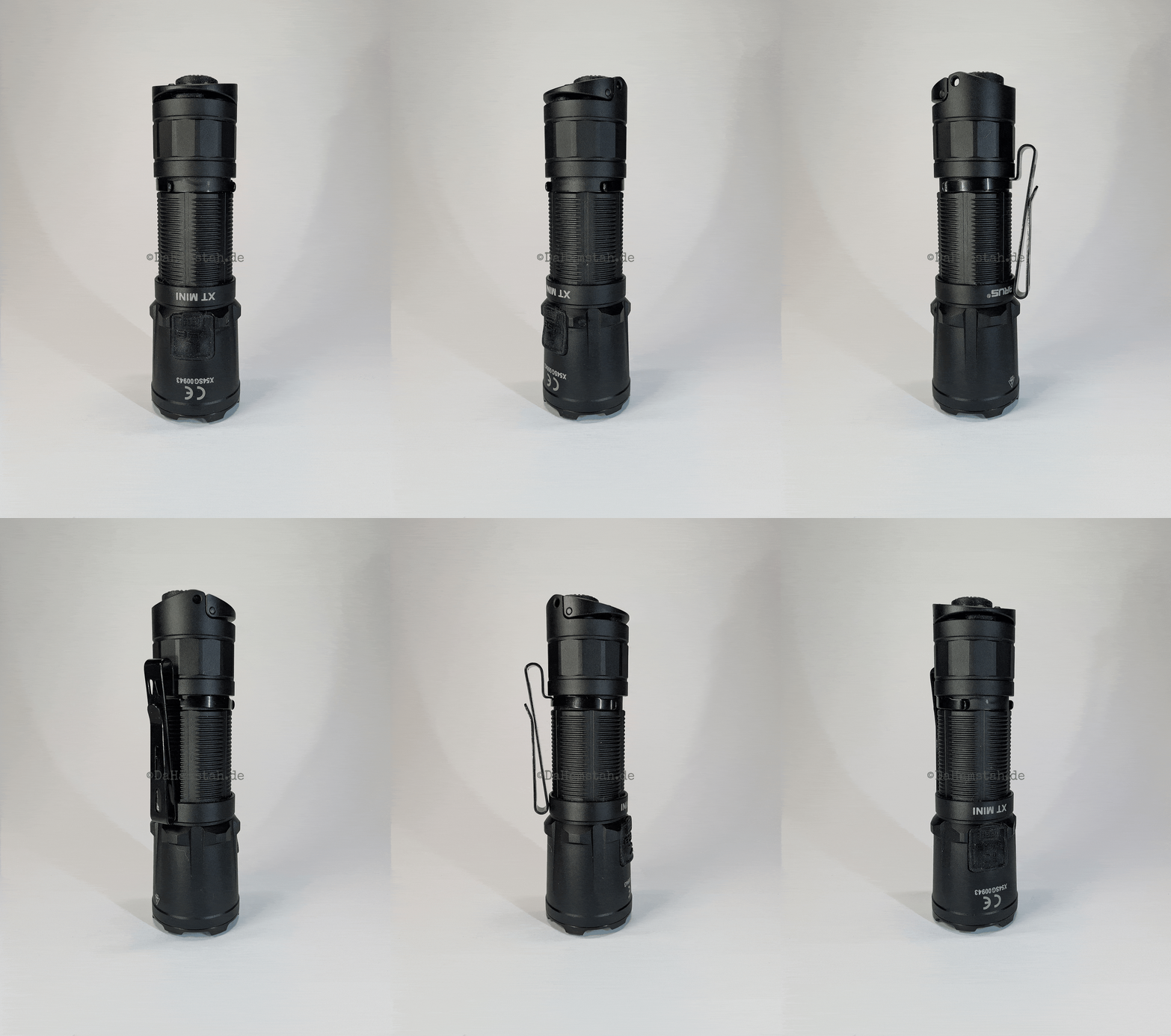
Disclaimer: Klarus provided me with this light free of charge. This had no influence on the review.
Introduction
So far I have had little contact with Klarus as a brand – occasionally read something about it, but apart from that I haven't dealt much with their products. When I then saw a post about the XT Mini, I was interested. Don't ask me why, somehow I was skeptical of the brand and hesitated for a long time before deciding to reach out to Klarus. The dual tail switch ended up fascinating me, though. Whether my skepticism was justified, you will read in the following review.
Specifications by KLARUS

The XT mini is only available in one version – black!
Package Contents and Impressions

Small light, small box! The XT Mini comes in a two-part, black box. Printed on it is a picture of the flashlight as well as all important data. The flashlight itself sits surprisingly tight in a white plastic tray. The battery is already inserted and is protected by an insulator. Additionally, a spare O-ring, a lanyard, a USB-A to C cable, a manual, and a small product catalog are included.


My first impression was that the flashlight, despite its size, is a really serious light. The flashlight appears extremely robust right at first glance. The anodization completes this impression. It is grippy, matte black, and flawless.


The integration of the two switches into the comparatively small tailcap is excellent. Even with gloves, everything can be operated flawlessly. Both switches have a good tactile feel. The main switch protrudes slightly, but is protected on the sides by the lanyard attachment eyelets. The function switch takes up only about 1/3 of the tailcap, but feels significantly larger.


The threads on the tailcap are anodized, so a mechanical lockout is possible. The wall thickness of the battery tube is on the thicker side for such a small light. The battery tube has extremely grippy grooves and cannot be removed from the head.


Klarus has continued the design on the flashlight head, this also feels very massive. The USB-C charging port is also located there. A rubber cover seals it flush and securely. So securely that I wasn't sure which way it opened the first time, because it didn't open easily in any direction. Even very thick charging cables fit without problems, provided you keep the cover from folding back with a finger.

The bezel stands out slightly, it is kept a bit glossier. The width of the ring is quite impressive, especially compared to the size of the flashlight. Embedded in it are 3 ceramic glass breaker beads.


Behind the AR-coated lens sits the Luminus SFT-25R in a comparatively deep reflector, of course perfectly centered.


The small Klarus feels excellent in hand. With my medium-sized hands, the switches can be operated perfectly and the hand doesn't cast a shadow on any part of the beam.
Size

The small XT Mini tips the scales at a slim 87g including the battery.
For an 18350 light, the Klarus isn't small, rather the opposite. On the one hand, the switch concept requires space, on the other hand, the reflector is comparatively deep. The RRT01 and the TAC AA are comparable – both in terms of size, as well as switch and reflector.
You can find the dimensions of the flashlight in the following picture, rounded to the nearest mm in each case.

Carrying Options
Lanyard: A lanyard is included. The cord is round, pleasantly thick and slightly elastic. A slider helps to secure the loop on the wrist. This works wonderfully attached to one of the eyelets on the tailcap.
Clip: The two-way clip has good tension in both directions. The part closer to the flashlight has a good opening and rests on a smooth surface – perfect for protecting the fabric the light is clipped to.

The opposite part, which is mainly intended for use on a baseball cap for example, also has a good opening, but is almost a bit too tight for thicker caps. Two-way clips are always a compromise and Klarus made a good decision here in my eyes. If this part of the clip were wider, carrying it in a pants pocket would be significantly more uncomfortable.
Magnet: There is no magnet.
(Jacket)pocket: Any pocket is absolute comfort territory for this light. There it can show off its dimensions and is hardly noticeable. Even without a lockout the light is unlikely to turn on, but you should still lock it mechanically or electronically, as the paddle switch has no further protection.
UI

The operation of the XT Mini is more than successful. Such a comprehensive yet simple user interface shows that Klarus has experience with dual-switch flashlights. It clearly caters more to the tactical target group. Unlike many other flashlights that take the same approach, the XT Mini also shows no weaknesses in civilian / EDC use.
Klarus calls the electronic switch Auxiliary Switch, I will abbreviate this to AUX in the following. The round switch is the main switch. Below you will find the table, as always. However, this does a poor job of conveying how simple the operation is. Therefore, I want to try explaining it in words first.
The main switch always turns the flashlight onto Turbo, no matter what state the light is in. A half-press gives momentary output, a full press gives constant on. If the Turbo turns off, the flashlight is off, no matter what state it was in before. If you turned the light on in Turbo, you cycle through the brightness levels from High to Low.
The AUX switch starts the flashlight optionally in Low or with mode memory. Every additional click cycles through the brightness levels from Low to High. A short (half) press on the main switch turns the flashlight off. 5s after you have turned the flashlight on with the AUX switch, it also turns the flashlight off – without a brief Turbo flash.
Of course, there is also Strobe – no matter what state the flashlight is in (except locked out), holding down the AUX switch activates it. If you hold it down briefly, only momentarily, if you hold it down for longer than 3s, then constantly.
| State of the light | Action | Result |
|---|---|---|
| off | Main switch half / full press | high momentary / constant on |
| off | AUX 1C | low / memory |
| off | 5C | Select low or memory for AUX |
| Off / On | AUX 1H | Strobe |
| Off / On | AUX 2C | SOS -> Beacon |
| off | AUX 3C | lock / unlock |
| locked | AUX 1C | low |
| on via main switch | AUX 1C | change brightness levels in descending order |
| on via AUX-switch (<5s since turn on) | AUX 1C | change brightness levels in ascending order |
| on via AUX-switch (>5s since turn on) | AUX 1C | off |
Beam Profile and Measurements
All measurements were done in my 30cm integrating sphere. The temperature was between 20 and 24°C. Additionally, an Opple Light Master III and a TASi TA636B lux meter were used. Please note that this is hobby equipment, so inaccuracies and deviations are possible!
Output and Beam
The beam profile is good. A clear, defined spot is surrounded by useful, but not overpowering spill. There are few artifacts. Only a slightly darker ring around the spot. However, you only see this on a white wall. There is no tint shift or a discolored spot, although the SFT-25R doesn't exactly have the best reputation there. Overall, the beam profile fits the intended purpose of the flashlight very well!
The performance is difficult to evaluate for such a light. 18350s are small batteries with low capacity, and in addition, the flashlight is probably meant more for short bursts of light and not for continuous operation. Not that this could cause damage, it's just my interpretation of the measurement results.

High steps down almost immediately, until it lands roughly at the medium brightness level after about 1 minute. There, the brightness curve seems to follow the battery voltage. Klarus nowhere mentions ANSI FL1 – in contrast to other manufacturers who specify according to this standard with the same behavior without adhering to it, I find Klarus's version better.
| Max. in 1st minute | Lumens at 30s | max. temperature | Temp. @ 30s | runtime | ANSI FL1 runtimes | |
|---|---|---|---|---|---|---|
| Klarus XT Mini high | 930 lm | 418 lm | 39.6 °C | 27.5 °C | 6h 11min | 2h 15min |
| Klarus XT mini mid | 230 lm | 228 lm | 40.7 °C | 26.6 °C | 8h 54min | 5h 30min |
| Klarus XT mini low | 43 lm | 42 lm | 28.1 °C | 27.3 °C | 17h 24min | 15h 53min |
At a distance of one meter I measured 25500 cd and thus a throw of 319m.
The following chart shows how the brightness is distributed roughly according to human perception. The levels are well chosen and evenly distributed.

CCT, CRI, DUV, PWM
| Low | Turbo | |
| CCT | 5900K | 6400K |
| CRI | 68 | 70 |
| DUV | 0.006 | 0.003 |
Flicker is in the green zone on all levels. PWM is visible with the camera, however in a range that shouldn't be bothersome. The raw data from the flicker test also points to this.
All measurement results can be found here


Beamshots
I replaced the TS10 from the size comparison with a Trustfire L2 pro, as this has a significantly more similar design approach to the XT Mini. Before that, I want to show you some impressions of the beam. All pictures in the comparison were taken with identical camera settings.


Batteries and charging

A comparatively simple, linear charge controller is presumably built into the light. This starts off with a sporty 1.4A – which is still under 1C and uncritical, yet unusual for this battery size. The charging current then drops quickly and continuously. While this stretches out the charging time a bit, it is rather gentle on the battery.
Not so nice is the high current after termination. Li-ion cells don't really like this – if you often leave the flashlight on the charger for a longer time after charging is complete, it can lead to premature aging of the cell.
The charging function can therefore be used without hesitation. You should just unplug the flashlight promptly after completion if you care about the maximum lifespan of the cell.
The flashlight also works with CR123 batteries. Accordingly, there is no low voltage protection (LVP) built in for Li-ion batteries – so protected batteries, like the included one, are highly recommended!
The battery is specified at 1600mAh, my Vapcell S4+ measured 1731mAh.
The small light cannot be used as a power bank, not really surprising with an 18350 battery.
The flashlight cannot be used while charging.
Summary
I thoroughly like the small Klarus. The build quality is on an outstanding level – the flashlight absolutely feels like a premium light! Both switches have a great tactile feel, the operation is absolutely spot-on. The really good UI also matches this.
The initial output is good for the size, the sustained output is not bad. The runtime, on the other hand, is really good! You have to make minor compromises regarding the regulation, but I find that acceptable – because the flashlight already offers a lot for its price and the 18350 only delivers sustained power to a limited extent. If I could wish for one thing for this flashlight, however, it would be a slightly more constant sustained output.
I am not a tactical user, but the UI of the XT Mini is one of the few that I can imagine using in relevant scenarios. The operation also works wonderfully in civilian use. Klarus has created a great little all-rounder that cuts a fine figure in very many situations, both standalone and as a backup!
If your interest is piqued now, then check out the XT Mini at KLARUS!